MG to ML Conversion: Complete Guide with Formula, Examples, and Conversion Chart
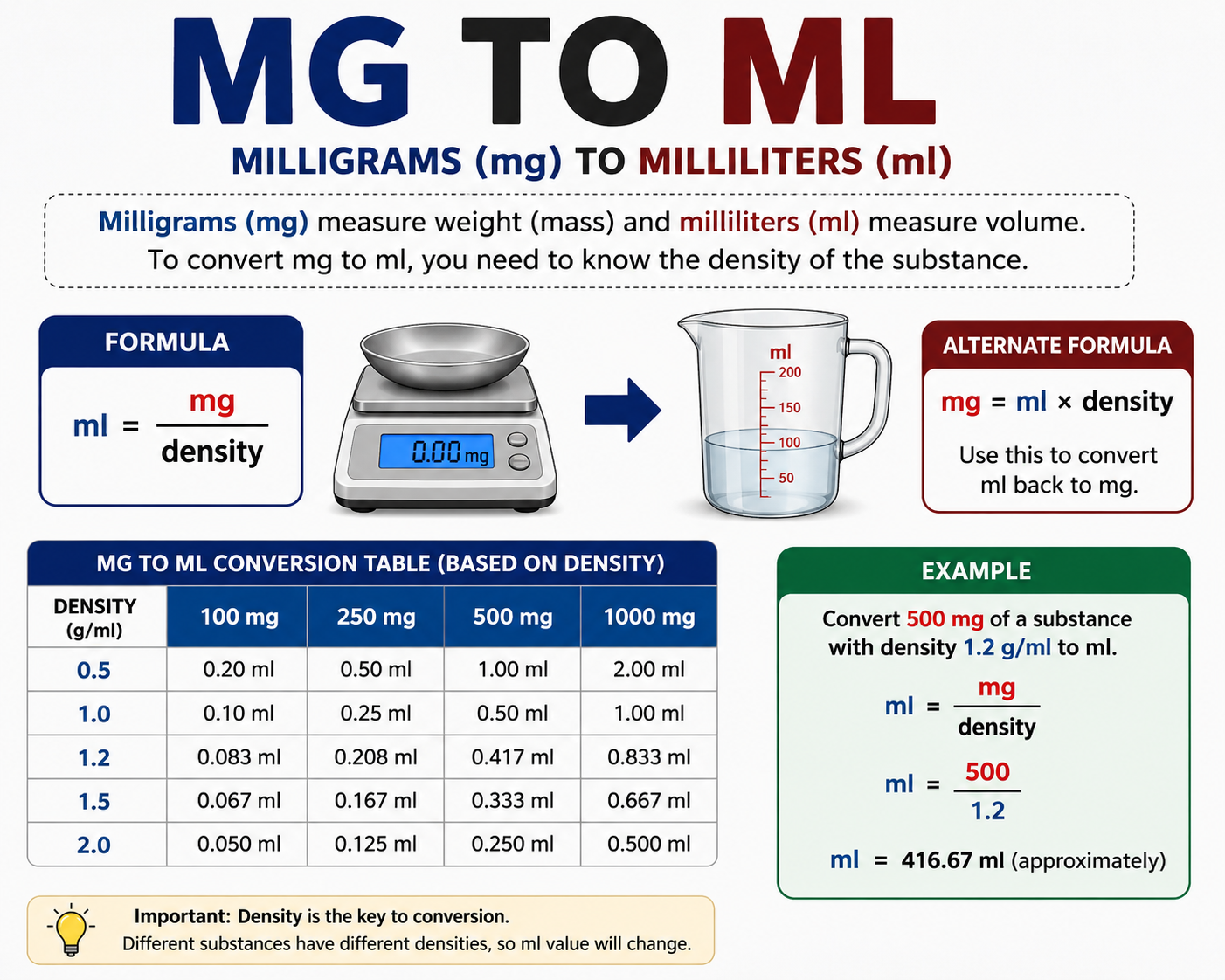
Understanding mg to ml conversion is essential when measuring medications, supplements, liquid chemicals, and nutritional products. Many people assume that milligrams and milliliters measure the same thing, but they are completely different units. Milligrams measure weight or mass, while milliliters measure volume.
Because these units measure different properties, there is no universal conversion. To accurately convert milligrams into milliliters, you must know the density or concentration of the substance.
This guide explains everything you need to know, including the conversion formula, real-world examples, conversion charts, common mistakes, and answers to frequently asked questions.
What Does MG Mean?
MG stands for milligram, a unit of mass in the metric system.
One milligram equals:
- 0.001 grams
- 1,000 micrograms (mcg)
- One-millionth of a kilogram
Milligrams are commonly used to measure:
- Medicines
- Vitamins
- Minerals
- Food additives
- Chemical compounds
For example:
- 500 mg of vitamin C
- 250 mg of ibuprofen
- 1000 mg of calcium
What Does ML Mean?
ML stands for milliliter, a unit of volume.
One milliliter equals:
- One-thousandth of a liter
- One cubic centimeter (cc)
Milliliters are used to measure liquids such as:
- Liquid medicines
- Water
- Milk
- Juice
- Syrups
- Oils
For example:
- 5 ml cough syrup
- 250 ml milk
- 500 ml water
Why MG Cannot Be Directly Converted to ML
This is one of the biggest misconceptions.
Milligrams measure mass, while milliliters measure volume.
Imagine these examples:
- 100 mg of honey
- 100 mg of water
- 100 mg of cooking oil
Although they all weigh 100 mg, each occupies a different volume because every liquid has a different density.
That is why the density or concentration must always be known before converting.
MG to ML Formula
The standard conversion formula is:
Milliliters (ml) = Milligrams (mg) ÷ Density (mg/ml)
Another way to write it is:
ML = MG ÷ Concentration
This formula works for medications, laboratory solutions, food ingredients, and many other liquids.
Understanding Density
Density tells you how much mass is contained in one milliliter of a liquid.
For example:
| Substance | Density |
|---|---|
| Water | 1000 mg/ml |
| Olive Oil | About 910 mg/ml |
| Honey | About 1420 mg/ml |
| Ethanol | About 789 mg/ml |
Different substances have different densities.
Therefore:
100 mg of water does not occupy the same volume as 100 mg of honey.
Medication Concentration Explained
Many medications list concentration rather than density.
For example:
- 125 mg per 5 ml
- 250 mg per 5 ml
- 500 mg per 10 ml
These concentrations make conversion much easier.
Example 1
Medicine concentration:
250 mg per 5 ml
Need:
500 mg
Calculation:
500 ÷ 250 = 2
2 × 5 ml = 10 ml
Answer:
500 mg equals 10 ml.
Example Using Water
Water has a density of approximately:
1000 mg/ml
Suppose you have:
500 mg water
Calculation:
500 ÷ 1000 = 0.5 ml
Answer:
500 mg of water equals 0.5 ml.
Example Using Honey
Honey density:
1420 mg/ml
Need:
5000 mg honey
Calculation:
5000 ÷ 1420 = 3.52 ml
Answer:
5000 mg honey equals approximately 3.52 ml.
Example Using Olive Oil
Density:
910 mg/ml
Need:
1000 mg
Calculation:
1000 ÷ 910 = 1.10 ml
Answer:
1000 mg olive oil equals approximately 1.10 ml.
Quick MG to ML Conversion Chart for Water
This chart assumes the liquid is water.
| MG | ML |
|---|---|
| 100 mg | 0.1 ml |
| 250 mg | 0.25 ml |
| 500 mg | 0.5 ml |
| 750 mg | 0.75 ml |
| 1000 mg | 1 ml |
| 2000 mg | 2 ml |
| 5000 mg | 5 ml |
| 10000 mg | 10 ml |
These values are only accurate for water.
Common Medication Conversion Examples
125 mg per 5 ml
| Dose Needed | Volume |
|---|---|
| 125 mg | 5 ml |
| 250 mg | 10 ml |
| 375 mg | 15 ml |
| 500 mg | 20 ml |
250 mg per 5 ml
| Dose Needed | Volume |
|---|---|
| 250 mg | 5 ml |
| 500 mg | 10 ml |
| 750 mg | 15 ml |
| 1000 mg | 20 ml |
500 mg per 5 ml
| Dose Needed | Volume |
|---|---|
| 500 mg | 5 ml |
| 1000 mg | 10 ml |
| 1500 mg | 15 ml |
| 2000 mg | 20 ml |
Always follow the dosage instructions on the medication label or as directed by a healthcare professional.
Step-by-Step Guide to Convert MG to ML
Follow these simple steps.
Step 1
Find the concentration or density.
Example:
250 mg per 5 ml
Step 2
Identify the required dose.
Example:
500 mg
Step 3
Use the formula.
500 ÷ 250 = 2
Step 4
Multiply by the listed volume.
2 × 5 ml = 10 ml
Answer:
500 mg equals 10 ml.
When Do You Need This Conversion?
People commonly convert milligrams into milliliters for:
- Liquid antibiotics
- Children’s medicines
- Veterinary medicines
- Vitamin syrups
- Nutritional supplements
- Essential oils
- Laboratory chemicals
- Cosmetic formulations
Common Mistakes to Avoid
Assuming 1 MG Always Equals 1 ML
This is incorrect.
It only works under very specific concentrations and should never be assumed.
Ignoring Density
Without density, the conversion cannot be accurate.
Guessing Medication Dosages
Always use the concentration printed on the label.
Mixing Weight and Volume
Remember:
- MG measures weight.
- ML measures volume.
These are different measurements.
MG to ML Conversion for Children’s Medicine
Parents often receive prescriptions in milligrams, while medicine cups are marked in milliliters.
For example:
Prescription:
250 mg
Bottle label:
125 mg per 5 ml
Calculation:
250 ÷ 125 = 2
2 × 5 = 10 ml
Correct dose:
10 ml
Double-check your calculations and use the measuring device provided with the medication.
MG to ML in Nutrition
Many liquid supplements provide nutrient amounts in milligrams.
For example:
Supplement label:
100 mg per 1 ml
Desired intake:
300 mg
Calculation:
300 ÷ 100 = 3 ml
Answer:
Take 3 ml.
Always verify the serving concentration on the product label.
MG to ML in Laboratory Settings
Scientists frequently convert milligrams into milliliters while preparing solutions.
For example:
Desired solution:
2500 mg
Concentration:
500 mg/ml
Calculation:
2500 ÷ 500 = 5 ml
Laboratory measurements require precision, so calibrated equipment should always be used.
Tips for Accurate Conversion
For the most accurate results:
- Read the product label carefully.
- Identify the concentration before calculating.
- Use the correct formula.
- Measure liquids with an oral syringe or calibrated measuring cup.
- Recheck your calculations before administering medication.
- When in doubt, ask a pharmacist or healthcare provider.
Can You Convert MG to ML Without Density?
No.
Without density or concentration, the conversion cannot be calculated accurately.
For example:
500 mg could equal:
- 0.5 ml
- 0.75 ml
- 1 ml
- 2 ml
The correct answer depends entirely on the specific substance.
People Also Ask
Is 1000 mg equal to 1 ml?
Not always.
It equals 1 ml only when the substance has a density of 1000 mg/ml, such as pure water under standard conditions.
How do I calculate mg to ml?
Use this formula:
ML = MG ÷ Density (MG/ML)
If a medicine label lists concentration instead of density, divide the required milligrams by the concentration and adjust for the labeled volume.
Is mg bigger than ml?
Neither unit is bigger because they measure different things.
- MG measures mass.
- ML measures volume.
Can I convert any medication from mg to ml?
Yes, but only if you know the medication’s concentration.
Why do medicine bottles show both mg and ml?
The milligrams indicate the amount of active ingredient, while milliliters indicate the volume of liquid containing that ingredient.
Is 5 ml always equal to 500 mg?
No.
The amount depends entirely on the concentration of the medication or liquid.
FAQ
What is the easiest way to convert mg to ml?
Use the formula:
ML = MG ÷ Density (MG/ML)
If you’re converting a medication, use the concentration printed on the label.
Can I use an online calculator?
Yes. An online calculator can simplify the process, but you should still verify the concentration or density before relying on the result.
Why are medication labels written in both mg and ml?
The label shows the amount of active ingredient in a specific volume, making it easier to measure the correct dose accurately.
What measuring tool should I use?
For liquid medicines, an oral syringe is generally the most accurate. Measuring cups or dosing spoons supplied with the medication are also appropriate when used correctly.
What should I do if I’m unsure about a conversion?
Do not guess. Consult a pharmacist, healthcare provider, or the product manufacturer for guidance.
Conclusion
Converting mg to ml is straightforward once you understand that milligrams measure mass and milliliters measure volume. Because these units represent different physical properties, there is no universal conversion. The key is knowing the substance’s density or the product’s concentration.
Whether you’re measuring medication, preparing laboratory solutions, or using nutritional supplements, applying the correct formula ensures accuracy and safety. Always read product labels carefully, use proper measuring tools, and verify your calculations before administering or consuming any liquid product. By following these best practices, you can confidently perform accurate conversions whenever they are needed.
Related Posts

Wednesday Addams

Billboard Hot 100