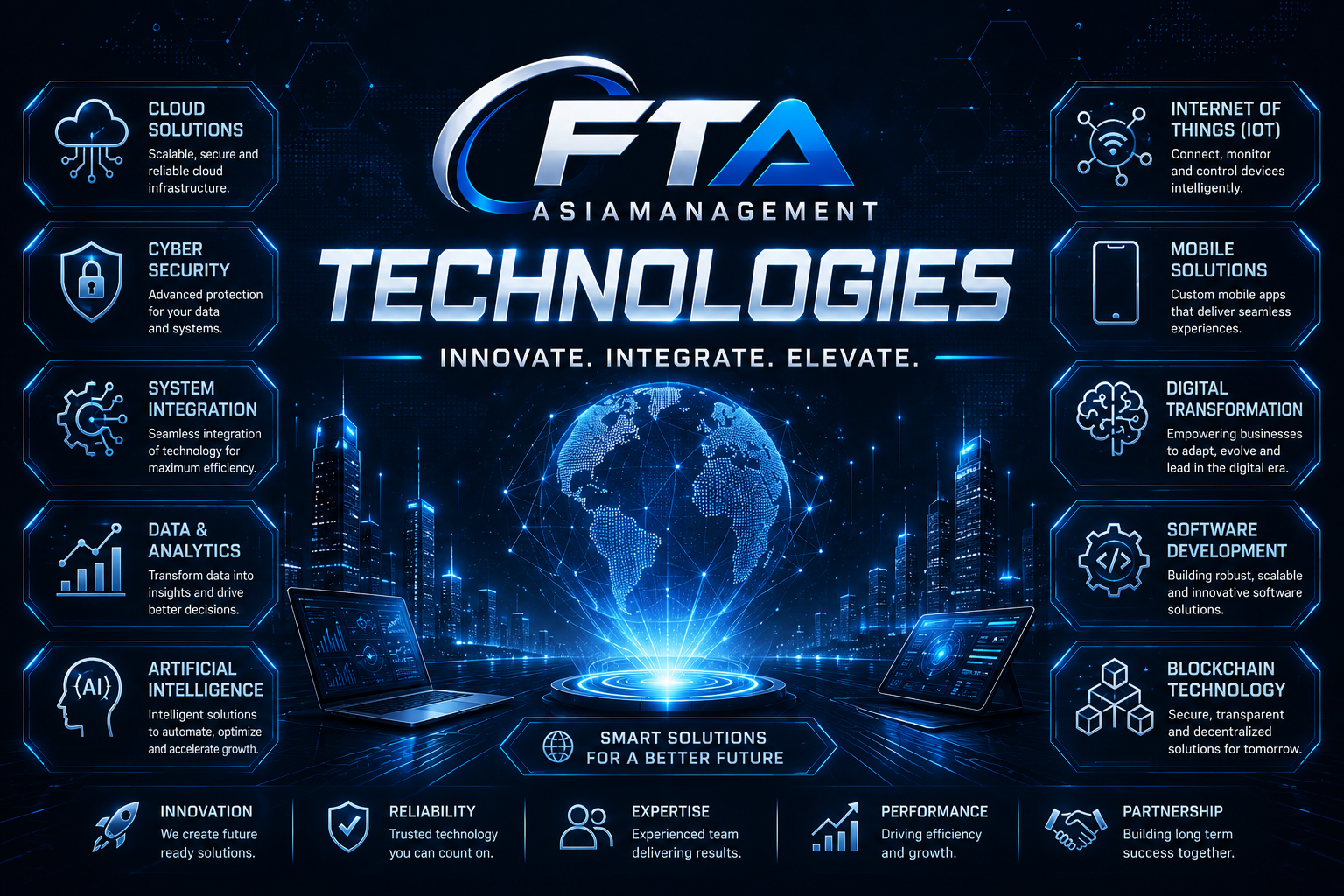
Technologies FTAsiaManagement
Technology has become the foundation of modern business success. Organizations across industries rely on digital solutions to improve productivity, reduce operational costs, strengthen security, and deliver better customer experiences. This growing demand for innovation has increased interest in technologies FTAsiaManagement, a term associated with modern business technology, enterprise transformation, and digital management strategies.
Companies no longer compete solely through products or pricing. Instead, they compete by using intelligent systems, automation, cloud infrastructure, artificial intelligence, cybersecurity, and data-driven decision-making. Businesses that embrace these technologies can respond faster to market changes while improving efficiency across every department.
This guide explores the technologies commonly associated with FTAsiaManagement, explains how they support business growth, discusses emerging trends, highlights implementation challenges, and provides practical recommendations for organizations planning their digital transformation journey.
What Is Technologies FTAsiaManagement?
Technologies FTAsiaManagement refers to the collection of digital tools, enterprise systems, and emerging innovations that help organizations improve operations, manage resources effectively, and make smarter business decisions.
Rather than focusing on a single software platform, the concept includes a wide range of technologies that support modern business management.
These technologies typically include:
- Artificial Intelligence (AI)
- Machine Learning
- Cloud Computing
- Big Data Analytics
- Cybersecurity
- Internet of Things (IoT)
- Blockchain
- Enterprise Resource Planning (ERP)
- Customer Relationship Management (CRM)
- Robotic Process Automation (RPA)
Together, these technologies create an ecosystem that enables businesses to become more agile, scalable, and competitive.
Why Modern Businesses Need Advanced Technology
Digital transformation is no longer optional. Customer expectations continue to rise while competition becomes increasingly global.
Businesses need technology because it helps them:
- Improve operational efficiency
- Reduce manual work
- Enhance customer satisfaction
- Increase productivity
- Strengthen cybersecurity
- Make data-driven decisions
- Scale operations more efficiently
- Support remote and hybrid work environments
Organizations that invest in digital innovation often experience faster growth compared to businesses that continue relying on outdated systems.
Core Technologies Behind FTAsiaManagement
Artificial Intelligence
Artificial Intelligence is transforming nearly every industry by enabling computers to perform tasks that traditionally required human intelligence.
Business applications include:
- Intelligent customer support
- Virtual assistants
- Predictive analytics
- Fraud detection
- Personalized recommendations
- Automated reporting
- Supply chain optimization
AI also helps executives identify trends before they become obvious, leading to better strategic decisions.
Machine Learning
Machine Learning is a branch of AI that allows systems to improve automatically using historical data.
Examples include:
- Demand forecasting
- Customer segmentation
- Risk analysis
- Marketing optimization
- Sales forecasting
- Inventory prediction
Machine learning becomes more accurate as additional business data becomes available.
Cloud Computing
Cloud technology has fundamentally changed how organizations manage IT infrastructure.
Key benefits include:
- Lower infrastructure costs
- Remote accessibility
- Better scalability
- Automatic updates
- Simplified collaboration
- Improved disaster recovery
Instead of purchasing expensive servers, businesses can access computing resources whenever needed.
Big Data Analytics
Modern companies generate enormous amounts of information every day.
Big Data Analytics helps organizations analyze:
- Customer behavior
- Website traffic
- Financial performance
- Employee productivity
- Market trends
- Product demand
- Operational efficiency
Instead of making assumptions, executives can make decisions based on measurable evidence.
Benefits of Data Analytics
Businesses gain several advantages:
- Faster decision-making
- Better forecasting
- Improved marketing campaigns
- Reduced waste
- Higher profitability
- Better customer experiences
Data has become one of the most valuable assets in today’s business environment.
Cybersecurity
As businesses become increasingly digital, cybersecurity has become a top priority.
Cyber threats continue evolving every year, making proactive security essential.
Important security technologies include:
- Multi-factor authentication
- Endpoint protection
- Network monitoring
- Data encryption
- Identity management
- Security awareness training
- Cloud security platforms
Strong cybersecurity protects sensitive information while maintaining customer trust.
Internet of Things (IoT)
IoT connects physical devices to the internet, allowing them to communicate automatically.
Examples include:
- Smart factories
- Connected vehicles
- Smart warehouses
- Healthcare monitoring devices
- Intelligent logistics systems
- Smart buildings
Businesses gain real-time visibility into operations while improving efficiency.
Blockchain Technology
Blockchain provides secure, transparent, and tamper-resistant record keeping.
Business applications include:
- Supply chain tracking
- Digital contracts
- Financial transactions
- Identity verification
- Healthcare records
- Asset management
Although often associated with cryptocurrencies, blockchain has many practical enterprise uses.
Enterprise Resource Planning (ERP)
ERP software integrates multiple business functions into one centralized system.
Departments commonly connected include:
- Finance
- Human Resources
- Inventory
- Procurement
- Manufacturing
- Sales
- Operations
ERP systems reduce duplication, improve reporting, and streamline workflows.
Customer Relationship Management (CRM)
CRM software helps organizations manage customer interactions throughout the sales journey.
CRM platforms support:
- Lead management
- Customer service
- Sales automation
- Marketing campaigns
- Customer retention
- Communication history
Businesses can deliver more personalized customer experiences while increasing revenue.
Robotic Process Automation (RPA)
RPA automates repetitive business tasks that previously required manual effort.
Examples include:
- Invoice processing
- Payroll management
- Data entry
- Report generation
- Compliance documentation
- Email processing
Automation allows employees to focus on higher-value activities.
How Technologies FTAsiaManagement Support Digital Transformation
Digital transformation involves more than purchasing new software.
Successful transformation requires:
- Business strategy alignment
- Employee training
- Process improvement
- Technology integration
- Leadership commitment
- Continuous optimization
Technology acts as an enabler rather than the final objective.
Organizations that combine people, processes, and technology typically achieve the strongest results.
Industries Benefiting from These Technologies
Healthcare
Healthcare organizations use technology to improve:
- Patient records
- Remote consultations
- Medical imaging
- Appointment scheduling
- Predictive diagnostics
- Hospital management
Banking and Finance
Financial institutions rely on digital technologies for:
- Fraud detection
- Mobile banking
- Digital payments
- Credit risk analysis
- Customer authentication
- Investment analytics
Retail
Retail businesses leverage technology for:
- Personalized shopping
- Inventory optimization
- Customer analytics
- Online commerce
- Dynamic pricing
- Supply chain visibility
Manufacturing
Manufacturers benefit through:
- Smart production
- Predictive maintenance
- Quality control
- Warehouse automation
- Robotics
- Production analytics
Education
Educational institutions increasingly depend on:
- Online learning platforms
- Student management systems
- Virtual classrooms
- AI tutors
- Learning analytics
- Digital assessments
Key Benefits for Businesses
Organizations implementing modern technologies often experience measurable improvements.
| Business Area | Potential Benefit |
|---|---|
| Productivity | Faster operations |
| Customer Service | Improved satisfaction |
| Security | Better protection |
| Costs | Lower operating expenses |
| Decision Making | Data-driven insights |
| Collaboration | Improved teamwork |
| Scalability | Easier expansion |
| Innovation | Faster product development |
Common Challenges During Technology Adoption
Despite the benefits, implementation is rarely without obstacles.
Common challenges include:
High Initial Investment
Modern enterprise systems often require significant upfront spending.
Organizations should evaluate long-term return on investment instead of focusing only on initial costs.
Employee Resistance
Some employees hesitate to adopt unfamiliar technologies.
Providing training and demonstrating clear benefits improves adoption.
Integration Issues
Older legacy systems may not integrate easily with modern platforms.
Organizations should develop detailed migration strategies before implementation.
Data Security Risks
Digital transformation increases the importance of protecting sensitive information.
Regular audits, employee education, and updated security protocols reduce risk.
Skill Gaps
Many organizations struggle to find professionals experienced in AI, cybersecurity, cloud computing, and advanced analytics.
Continuous learning programs help bridge these gaps.
Best Practices for Successful Technology Implementation
Organizations can maximize success by following proven strategies.
Define Clear Business Goals
Technology investments should support measurable objectives such as:
- Revenue growth
- Customer satisfaction
- Operational efficiency
- Cost reduction
Start with Small Projects
Pilot programs allow organizations to evaluate effectiveness before expanding implementation.
Prioritize Employee Training
Technology succeeds only when employees understand how to use it effectively.
Training should be continuous rather than a one-time event.
Monitor Performance
Organizations should track performance indicators such as:
- Productivity improvements
- Customer satisfaction
- System uptime
- Security incidents
- Revenue growth
- Cost savings
Update Systems Regularly
Software updates improve security, performance, and compatibility with emerging technologies.
Emerging Trends Shaping the Future
Technology continues evolving rapidly.
Several innovations are expected to influence businesses over the coming years.
Generative AI
Generative AI is helping businesses create:
- Marketing content
- Customer responses
- Software code
- Reports
- Product designs
Edge Computing
Processing information closer to connected devices reduces latency and improves performance.
Digital Twins
Digital twins allow organizations to simulate equipment, buildings, factories, and production systems before making real-world changes.
Green Technology
Businesses increasingly prioritize sustainable technology solutions that reduce energy consumption and environmental impact.
Hyperautomation
Hyperautomation combines AI, RPA, machine learning, and analytics to automate complex business processes across entire organizations.
How Small Businesses Can Benefit
Modern technology is no longer limited to large corporations.
Small businesses can improve competitiveness by adopting:
- Cloud accounting software
- Online collaboration platforms
- AI-powered customer support
- Marketing automation
- Inventory management systems
- Data analytics dashboards
Affordable subscription-based software has made advanced technology accessible to businesses of all sizes.
Choosing the Right Technology Strategy
Every organization has unique requirements.
Before investing, decision-makers should evaluate:
- Business objectives
- Budget
- Existing infrastructure
- Employee capabilities
- Security requirements
- Expected return on investment
- Scalability needs
- Vendor support
A structured technology roadmap reduces implementation risks while maximizing long-term value.
Frequently Asked Questions
What does technologies FTAsiaManagement refer to?
It generally refers to modern business technologies that support digital transformation, enterprise management, automation, cloud computing, artificial intelligence, cybersecurity, and data-driven decision-making.
Why is digital transformation important?
Digital transformation helps organizations improve efficiency, reduce costs, enhance customer experiences, strengthen security, and remain competitive in rapidly changing markets.
Which industries benefit the most?
Healthcare, finance, manufacturing, retail, logistics, education, telecommunications, and professional services all benefit significantly from modern digital technologies.
Is cloud computing essential for modern businesses?
Cloud computing provides flexibility, scalability, cost savings, remote accessibility, and simplified infrastructure management, making it an important component of many digital transformation strategies.
How can businesses begin adopting these technologies?
Organizations should identify business goals, assess current systems, prioritize high-impact projects, train employees, monitor results, and continuously improve their technology strategy.
Conclusion
The rapid pace of digital innovation continues to reshape how organizations operate, compete, and grow. The concept of technologies FTAsiaManagement reflects a broad ecosystem of modern solutions that enable businesses to improve efficiency, strengthen security, automate routine work, and make smarter decisions through data.
From artificial intelligence and cloud computing to cybersecurity, automation, blockchain, and advanced analytics, these technologies are no longer optional for organizations seeking long-term success. Businesses that combine the right technology with skilled employees, clear objectives, and continuous improvement are better positioned to adapt to changing markets and deliver lasting value to customers.
As emerging innovations continue to evolve, organizations that invest strategically in digital transformation will be more resilient, agile, and prepared for the future of business.
Related Posts

Donna Raye Bautista: Biography, Career, Family, Background, and Facts You Should Know

Taylor Breesey Face